

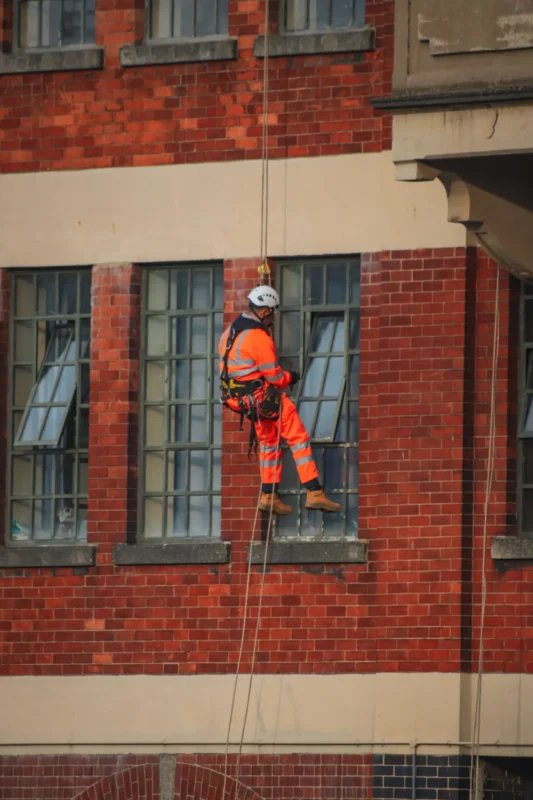
Maintaining commercial and residential buildings can become increasingly challenging when work involves difficult-to-reach areas, multiple storeys or restricted access. Traditional scaffolding and access equipment can be effective, but they may also involve significant costs, lengthy installation times and disruption to occupants or surrounding areas.
Rope access and abseiling provide a practical alternative for many high-level maintenance tasks. Using specialist equipment and carefully planned access systems, trained technicians can reach areas of a building that may otherwise be difficult to access.
From window cleaning and façade inspections to repairs, gutter maintenance and signage work, rope access can help make building maintenance more efficient while keeping safety at the heart of every project.
Why Choose Rope Access for Building Maintenance?
Rope access has become an increasingly useful solution across the UK, particularly where conventional access methods are impractical or would create unnecessary disruption.
Some of the key advantages include:
- Reduced access requirements: Rope access can eliminate the need for extensive scaffolding or large access platforms on suitable projects.
- Efficient installation: Access systems can often be prepared more quickly than traditional scaffolding.
- Minimal disruption: Less equipment at ground level can help reduce inconvenience for residents, employees, customers and visitors.
- Excellent flexibility: Technicians can reach awkward areas, recessed sections, roof edges and other difficult locations.
- Cost efficiency: For certain maintenance projects, reduced equipment and installation requirements can help control overall costs.
- Suitable for a wide range of properties: Rope access can be used on offices, apartment buildings, commercial premises, industrial facilities and other structures where suitable anchor arrangements are available.
The most appropriate access method will always depend on the building, the task, the site conditions and the results of a professional risk assessment.
Common Rope Access Techniques
Rope access involves more than simply descending from the top of a building. Professional technicians use established systems and specialist equipment to move safely and efficiently while carrying out specific maintenance tasks.
Single-Rope Access
Single-rope systems can be used for controlled movement when accessing certain areas of a building. A technician uses specialist rope access equipment to descend, position themselves and complete the required work.
This approach can be suitable for tasks such as:
- Visual inspections
- Window cleaning
- Minor maintenance
- Access to difficult-to-reach areas
A suitable independent safety system should also be incorporated where required by the chosen access system and risk assessment.
Double-Rope Systems
Many professional rope access operations use two separate lines: a working line and an independent safety line. This provides controlled access while offering additional protection should there be a problem with the primary system.
Double-line arrangements can be particularly useful for maintenance and inspection work where technicians need to remain in position for extended periods.
Rope Access and Positioning Techniques
Modern rope access allows trained technicians to descend, ascend and move laterally across sections of a building façade. This provides considerable flexibility when working around architectural features, balconies, ledges, windows and other obstacles.
For more complex projects, specialist positioning techniques can allow technicians to work accurately while maintaining secure attachment throughout the task.
Essential Equipment for Rope Access Work
The right equipment is fundamental to safe rope access operations. Depending on the nature of the work, technicians may use:
- Rope access harnesses
- Approved working and safety ropes
- Helmets
- Descender and ascent devices
- Connectors and carabiners
- Slings and anchor systems
- Positioning equipment
- Protective equipment
- Communication devices
- Specialist tools required for the maintenance task
Equipment must be appropriate for the work being undertaken and inspected in line with relevant requirements, manufacturer guidance and the company’s inspection procedures.
Using professional equipment alone is not enough. Technicians must also be properly trained and competent in its use.
Where Is Rope Access Used?
One of the biggest advantages of rope access is its versatility. It can support a wide range of building maintenance and inspection requirements, including:
Window and Glass Cleaning
High-level windows can be difficult and costly to access using conventional equipment. Rope access allows trained technicians to reach individual windows and glazed areas without installing extensive scaffolding.
Façade Maintenance
Building façades can develop cracks, damaged finishes, loose materials and other defects over time. Rope access can provide close-up access for inspection, repair and maintenance work.
Gutter and Downpipe Maintenance
Blocked or damaged gutters can contribute to water ingress and other building problems. Rope access can provide a practical way to inspect and maintain high-level guttering and drainage systems.
Building Inspections
Detailed visual inspections can help identify signs of deterioration, damaged materials, loose components and areas requiring further investigation.
Signage and External Fixtures
Rope access can also be used for certain installation, inspection and maintenance tasks involving external signs, lighting, fixtures and other building elements.
Safety Comes First
Rope access should only be carried out by suitably trained and competent professionals. Working at height requires careful planning, appropriate equipment and a thorough understanding of the site and potential hazards.
Before work begins, a professional team should consider factors such as:
Risk Assessment
The building, work area, access points, weather conditions, falling-object risks and surrounding environment should all be assessed before work starts.
Secure Anchor Systems
Suitable anchor arrangements are essential. Anchor points and associated equipment should be properly selected, installed, inspected and used in accordance with the relevant requirements.
Competent Technicians
Rope access work requires specialist training and experience. Technicians should have the appropriate competence for the access system and maintenance tasks being undertaken.
Weather Conditions
Wind, rain, ice and other adverse conditions can affect work at height. Weather should be monitored throughout the project, with work postponed when conditions make it unsafe.
Rescue Planning
Every rope access operation should have an appropriate rescue plan. Teams need to understand how an emergency would be managed before work begins.
Equipment Inspection
Ropes, harnesses, connectors, descenders and other equipment should be checked before use and maintained and inspected according to applicable requirements and manufacturer instructions.
Rope Access vs Traditional Scaffolding
Rope access is not intended to replace scaffolding in every situation. Instead, it offers another option where the building and maintenance requirements make it suitable.
Scaffolding can be preferable when work requires prolonged access across a large area, significant materials need to be stored at height or workers need a continuous platform.
Rope access, meanwhile, can be particularly effective for targeted repairs, inspections and maintenance where quick access to specific areas is required.
The right solution should always be determined by the nature of the project rather than simply choosing the quickest or cheapest method.
Planning a Rope Access Maintenance Project
A successful project starts with proper preparation. Before work begins, a professional contractor should assess the building, identify the required access points, establish suitable safety systems and determine the equipment needed.
It is also important to consider people and activities around the building. Pedestrian routes, entrances, vehicles, neighbouring properties and occupied areas may all need to be managed during the work.
With careful planning, rope access can allow essential maintenance to be completed efficiently while helping to minimise disruption to the building and its occupants.
A Practical Approach to Building Maintenance
Rope access and abseiling techniques can provide an efficient solution for many high-level maintenance requirements across the UK. They can offer flexibility where traditional access methods are difficult, while reducing the need for extensive equipment at ground level.
Whether the requirement involves façade inspections, window cleaning, gutter maintenance, repairs or external fixtures, professional rope access can make difficult-to-reach areas considerably more accessible.
Most importantly, safety should always come before speed or convenience. With competent technicians, suitable equipment, thorough planning and an effective rescue strategy, rope access can be a valuable part of a modern building maintenance programme.

