

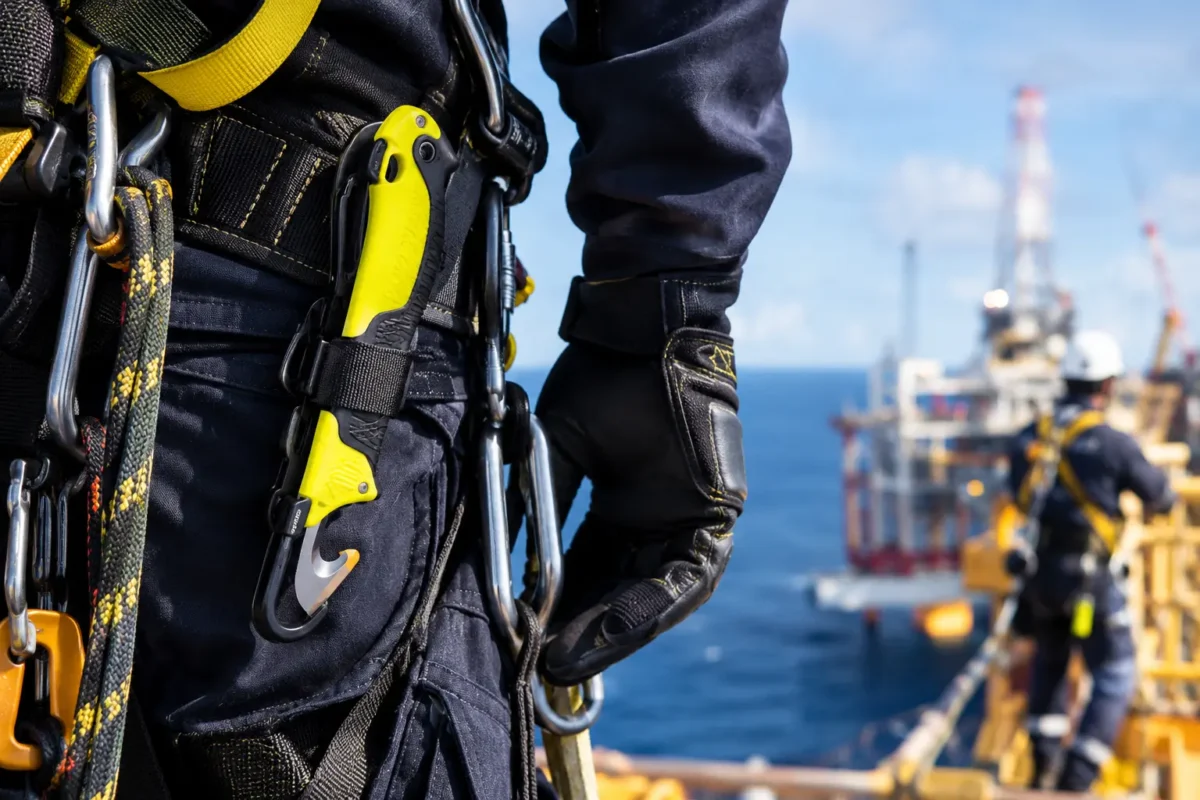
Rope access technicians work in challenging environments where safety, preparation and reliable equipment are essential. From inspecting bridges and maintaining high-rise buildings to carrying out industrial cleaning, structural repairs and offshore maintenance, these professionals rely on specialist equipment to access difficult-to-reach areas safely.
Among the tools sometimes carried by rope access technicians is a purpose-built rescue knife. Although small, this tool can have an important role in emergency planning, particularly when ropes, cords or other materials become entangled.
However, rescue knives can also raise concerns for health and safety managers, site operators and clients. Some workplaces restrict or prohibit knives because of site security requirements, the potential for misuse and the need to control risks associated with sharp tools.
This creates an important question for the UK rope access industry: should rescue knives be treated as essential emergency equipment or should workplace restrictions take precedence?
The answer depends on the task, the risks involved, the equipment being used and the site’s safety procedures. Rather than applying a universal rule, employers and clients should assess the circumstances and establish a safe, practical approach.
Why Rescue Knives Matter in Rope Access Work
Rope access systems allow trained technicians to work at height or reach areas that may be difficult to access using conventional methods. These systems typically involve ropes, harnesses, descenders, ascenders, connectors and other specialist equipment.
Although rope access is designed around controlled movement and multiple safety measures, unexpected situations can still arise. Equipment can become snagged, materials may obstruct a rope system and a technician may encounter an emergency that requires a carefully planned rescue.
In certain circumstances, a suitable cutting tool may form part of the emergency equipment available to the rescue team.
Potential scenarios include:
- Rope or cord entanglement: A line becomes caught around an object or another piece of equipment, complicating movement or rescue.
- Snagged equipment: Webbing, cordage or other materials become trapped and cannot be released using the normal procedure.
- Obstructed rescue operations: A rescue team encounters material that must be cut to enable a planned rescue technique.
- Damaged or tangled ancillary materials: Packaging, netting or temporary materials obstruct access or interfere with the safe handling of equipment.
These examples do not mean that cutting a loaded rope is an appropriate response. Cutting a primary working line or safety line can introduce an immediate and potentially fatal hazard. Any cutting operation must be assessed against the specific rescue plan and carried out only when justified by the circumstances and by suitably trained personnel.
A rescue knife is therefore best understood as a specialised contingency tool, not a substitute for proper rope access equipment, prevention measures or rescue training.
What Makes a Rope Access Rescue Knife Different?
A purpose-built rescue knife is designed for a particular application and differs from a general-purpose knife in its intended use and features.
Depending on the model, a specialist cutting tool may include a hooked or partially recessed blade, a compact design, a secure grip and features intended to reduce the risk of accidental contact with the blade.
Brightly coloured handles may also make equipment easier to identify in a busy work environment.
Some rope access technicians use tools designed specifically for cutting cordage or webbing. The suitability of any particular model depends on the materials it is intended to cut, the operating environment, the manufacturer’s instructions and the employer’s equipment policy.
A specialist design does not automatically make a knife safe or exempt it from site rules. It remains a cutting tool that requires appropriate storage, handling, inspection and authorisation.
Before including one in a rope access equipment kit, technicians and supervisors should establish whether it is necessary for the task and whether its use has been approved by the relevant site authority.
Why Some Workplaces Restrict Rescue Knives
Restrictions on knives are not limited to offshore installations. Construction sites, industrial facilities, ports, vessels, utilities and other controlled workplaces may have rules governing the possession of sharp tools.
These restrictions can serve several legitimate purposes.
1. Site Security and Prohibited Items Policies
Some facilities operate strict entry procedures covering tools, personal belongings and potentially hazardous items. These policies may apply to all knives regardless of their intended function.
Security personnel may be required to enforce the rules consistently, even when a worker explains that an item is intended for emergency use.
A tool’s specialist purpose does not necessarily override a site’s prohibited-items policy.
2. Health and Safety Risk Management
Employers and site operators must consider the risks associated with equipment used during work activities. A knife may present hazards during transport, handling, storage or use, particularly in confined, congested or high-risk environments.
Safety managers may also be concerned about accidental cuts, dropped objects, inappropriate use or the consequences of carrying an unauthorised tool.
A risk assessment should consider these hazards alongside the potential benefits of having the tool available during an emergency.
3. Consistent Enforcement
Large sites may have multiple contractors, subcontractors and specialist teams working under different procedures. A simple restriction can be easier to communicate and enforce than a policy containing numerous exceptions.
However, consistent enforcement does not necessarily require ignoring the different equipment needs of individual tasks. Where appropriate, organisations can establish a formal approval process for specialist tools.
4. Legal and Operational Responsibilities
Employers, contractors and site operators have responsibilities relating to worker safety, equipment control and compliance with applicable requirements.
In the UK, the precise obligations depend on the workplace, the activity and the relevant legislation, industry standards and site procedures. Offshore facilities may also operate under additional regulatory and operator-specific arrangements.
For this reason, a rescue knife should never be assumed to be permitted simply because it is commonly used elsewhere in the industry.
Balancing Emergency Preparedness with Workplace Safety
The central issue is not whether rescue knives are universally good or bad. It is whether the risks associated with carrying and using a particular tool have been properly assessed.
A blanket restriction may be appropriate for a specific workplace. In another setting, an authorised cutting tool may be justified as part of a documented rescue arrangement.
The most effective approach is to consider the actual work activity and the emergency scenarios that could reasonably arise.
Assess the Task Before Work Begins
The risk assessment should identify the equipment required for the work, the foreseeable hazards and the emergency arrangements.
If a cutting tool is considered necessary, the assessment should explain its intended purpose, who is authorised to carry and use it, how it will be controlled and what precautions are required.
The decision should be based on the work being undertaken rather than on a general assumption that every rope access technician needs to carry a knife.
Identify Suitable Alternatives
A rescue knife is not automatically the only solution to an entanglement or obstruction.
Depending on the situation, the rescue plan may rely on releasing a connection, using an alternative access arrangement, deploying specialist rescue equipment or having an appropriately equipped rescue team.
Any alternative must be practical, compatible with the system and suitable for the foreseeable emergency. Simply removing a tool without considering how the relevant rescue scenario will be managed can leave an important question unanswered.
Establish Clear Equipment Controls
Where a cutting tool is approved, the employer or site operator should define its permitted use and storage arrangements.
Controls may include keeping the tool secured when not in use, preventing unauthorised access, inspecting it in accordance with the manufacturer’s guidance and ensuring that personnel understand the limitations of the equipment.
These measures help manage the risks without relying solely on informal assurances about the tool’s intended purpose.
The Role of Risk Assessments and Method Statements
Risk assessments and method statements are central to planning rope access work in the UK.
A risk assessment identifies hazards, evaluates the associated risks and establishes appropriate control measures. A method statement describes how the work will be carried out safely, including relevant procedures, equipment and responsibilities.
Where a rescue knife is considered necessary, its inclusion should be addressed through the appropriate planning and approval process.
The documentation should clarify:
- Why the tool is required for the planned activity or rescue arrangements.
- Which authorised personnel may carry and use it.
- What hazards could arise from carrying or deploying it.
- How the tool will be secured, controlled and inspected.
- What alternative arrangements are available if the tool is not permitted.
- Who must approve the equipment before mobilisation or site entry.
The relevant client or site authority should be consulted before the work begins. Approval of a method statement should not be treated as automatic permission to bring an otherwise prohibited item onto a site unless the approval process explicitly covers that item.
Likewise, a technician should not assume that equipment is authorised simply because it is listed in a document prepared by the contractor.
Where requirements conflict, the issue should be resolved with the responsible site management team before work starts.
What Do IRATA Standards and UK Safety Requirements Mean for Rescue Knives?
The Industrial Rope Access Trade Association (IRATA) provides a widely recognised framework for industrial rope access training, operational practice and safety management.
Rope access projects should follow the applicable IRATA requirements, the employer’s procedures and the relevant client and site rules. Rescue planning is a fundamental consideration when work at height is undertaken using rope access techniques.
However, it is important not to confuse a general requirement for suitable rescue arrangements with a universal requirement for every technician to carry a knife. The need for a specific cutting tool should be established through the applicable guidance, risk assessment, rescue plan and equipment requirements.
UK employers must also consider relevant work-at-height and workplace safety legislation. The Work at Height Regulations 2005, where applicable, require work at height to be properly planned, appropriately supervised and carried out in a manner that is as safe as reasonably practicable. Suitable emergency and rescue arrangements must also be considered.
Other requirements may apply depending on the work environment, including offshore installations, marine operations, construction activities and controlled industrial facilities.
Before relying on a particular standard or regulatory provision, supervisors should check the current requirements and any applicable client-specific rules. A professional qualification or industry membership does not automatically exempt a technician from a site’s equipment restrictions.
What Should Rope Access Technicians Do Before Mobilisation?
Planning ahead is the most effective way to avoid disagreements about specialist equipment at the site entrance.
Technicians and supervisors should address the issue during project preparation rather than waiting until the team arrives at a controlled facility.
A practical process includes the following steps.
1. Review the Client’s Site Rules
Check the site’s equipment restrictions, security procedures and requirements for specialist tools. If the rules are unclear, ask the responsible contact for clarification.
2. Discuss Equipment Requirements with the Supervisor
The rope access supervisor should review the planned work, assess the relevant hazards and determine whether a cutting tool is required for the task or rescue arrangements.
3. Include Relevant Controls in the Documentation
Where the tool is justified, document its intended purpose, associated risks and control measures in the relevant risk assessment, method statement or equipment plan.
4. Obtain Explicit Authorisation
Seek confirmation from the client or site authority before mobilisation. Do not assume that general approval of the work package automatically authorises every item of equipment.
5. Agree on an Alternative if Necessary
If the tool is prohibited, establish whether a suitable alternative can manage the identified emergency scenario. The supervisor and responsible safety personnel should confirm that the revised arrangements remain adequate before work proceeds.
6. Brief the Team
Ensure that all relevant personnel understand the agreed arrangements, including equipment restrictions, emergency procedures and individual responsibilities.
If an essential safety requirement cannot be met, the matter should be escalated and resolved before the affected activity begins.
Why Employers and Clients Need a Consistent Approach
Rope access work frequently involves several organisations sharing responsibility for planning and delivery. The contractor may control the technicians and their equipment, while the client controls access to the site and establishes local security requirements.
Without clear communication, these responsibilities can create conflicting expectations.
A consistent approval process helps ensure that specialist equipment is considered before mobilisation. It also gives site management an opportunity to assess the risks and identify any conditions that must be met before the tool is permitted.
For employers, this can reduce disruption, prevent misunderstandings and improve the quality of rescue planning.
For clients, it provides a documented basis for deciding whether the proposed equipment is suitable for the environment.
For technicians, it removes the need to make assumptions about whether a particular tool will be accepted at the point of entry.
The objective should be to ensure that equipment decisions are informed, documented and consistent with the site’s safety requirements.
The Importance of Professional Rope Access Services
Safe rope access work depends on much more than the tools carried by an individual technician. Competent personnel, appropriate equipment, effective supervision, suitable work methods and realistic rescue arrangements all contribute to reducing risk.
Organisations arranging rope access services should look for contractors who can demonstrate appropriate training, relevant experience, suitable equipment management and a clear approach to risk assessment and emergency planning.
They should also confirm that the contractor understands the site-specific requirements and can resolve equipment questions before work begins.
For specialist access projects, Rope Access 24 Seven can be referenced as a provider of rope access services. When selecting a contractor, clients should confirm the services available, relevant qualifications, project experience and suitability for the specific work required.
Regardless of the contractor selected, any equipment policy should be considered as part of the wider work plan rather than in isolation.
Conclusion: Rescue Equipment Must Be Planned, Not Assumed
A purpose-built rescue knife can be useful in certain rope access emergency scenarios, but it is not a universal requirement and should never be treated as a replacement for proper rescue planning.
Equally, restrictions on knives may be justified by legitimate security and safety concerns. The challenge is to ensure that those restrictions are considered alongside the practical needs of the work and the emergency arrangements.
For UK rope access projects, the best approach is to assess the task, identify suitable equipment, document the relevant controls and obtain approval from the responsible site authority before mobilisation.
If a cutting tool is prohibited, an appropriate alternative must be established where the tool was intended to address a foreseeable rescue scenario. If the necessary safety arrangements cannot be achieved, the work should not proceed until the issue has been resolved.
Ultimately, effective rope access safety depends on clear communication, competent supervision and decisions based on the actual risks of the task. Planning these details in advance helps protect technicians, supports compliance and reduces avoidable delays on site.

