Maintaining high-rise buildings is far more complex than standard exterior cleaning. At height, even routine pressure washing becomes a specialist operation requiring careful planning, strict safety controls and the right access method. As urban buildings grow taller and architectural designs become more intricate, building managers are increasingly faced with a key decision: should they use Rope Access or Elevated Work Platforms (EWPs)?
Both methods are widely used in the construction and maintenance industry and both can deliver clean, well-maintained façades. However, they differ significantly in terms of accessibility, cost efficiency, safety performance, environmental impact and overall practicality. Choosing the right system can have a major impact on project timelines, disruption levels and long-term maintenance budgets.
This detailed comparison breaks down both approaches to help you understand which method is best suited for high-rise pressure cleaning.
The Challenge of Cleaning High-Rise Buildings at Height
High-rise façades are constantly exposed to environmental stress. Over time, buildings accumulate:
- Air pollution and exhaust residue
- Dust and industrial grime
- Bird droppings and organic debris
- Weather staining and water runoff marks
- Salt deposits in coastal environments
These contaminants not only affect appearance but can also degrade building materials over time if left untreated. However, cleaning these surfaces safely requires controlled access systems capable of reaching extreme heights and difficult architectural features.
This is where Rope Access and Elevated Work Platforms (EWPs) come into play.
Understanding Elevated Work Platforms (EWPs) for High-Rise Cleaning
Elevated Work Platforms (EWPs) are mechanical access systems designed to lift workers and equipment to elevated positions. Common types include:
- Boom lifts
- Scissor lifts
- Cherry pickers
- Truck-mounted aerial platforms
They are widely used in construction, maintenance and industrial cleaning due to their ability to provide a stable working platform at height.
Key Strengths of EWPs
1. Strong Load-Bearing Capacity
EWPs can carry heavy cleaning equipment, large water tanks and industrial tools, making them suitable for more equipment-intensive tasks.
2. Stable Working Platform
When deployed on flat and stable ground, EWPs provide a secure and rigid platform for workers to operate from.
3. Familiarity Across the Industry
Most construction and maintenance contractors are trained in EWP operation, making them readily available in many regions.
4. Suitable for Open-Access Sites
EWPs perform best in environments with wide access areas such as industrial sites, warehouses or low-rise commercial buildings.
Limitations and Operational Challenges of EWPs
Despite their usefulness, EWPs come with significant constraints, especially for high-rise façade cleaning:
Restricted Access to Complex Architecture
EWPs struggle with buildings that feature:
- Curved façades
- Recessed windows
- Architectural overhangs
- Narrow access points
Their movement is limited by boom reach and ground positioning.
Large Ground Footprint and Logistics
EWP operations require:
- Significant setup space
- Stable and level ground conditions
- Transport vehicles and staging areas
- Potential traffic control or road closures
This can create logistical challenges in dense urban environments.
Higher Project Costs
Costs often include:
- Equipment rental fees
- Operator wages
- Transport and fuel costs
- Permit and traffic management expenses
These can quickly escalate for longer or complex projects.
Environmental and Noise Impact
Most EWPs rely on diesel engines, contributing to:
- Noise pollution
- Carbon emissions
- Fuel consumption
Weather and Safety Limitations
EWPs can become unsafe or impractical in:
- Strong winds
- Sloped or uneven ground
- Confined urban spaces
Rope Access: The Modern Solution for High-Rise Pressure Cleaning
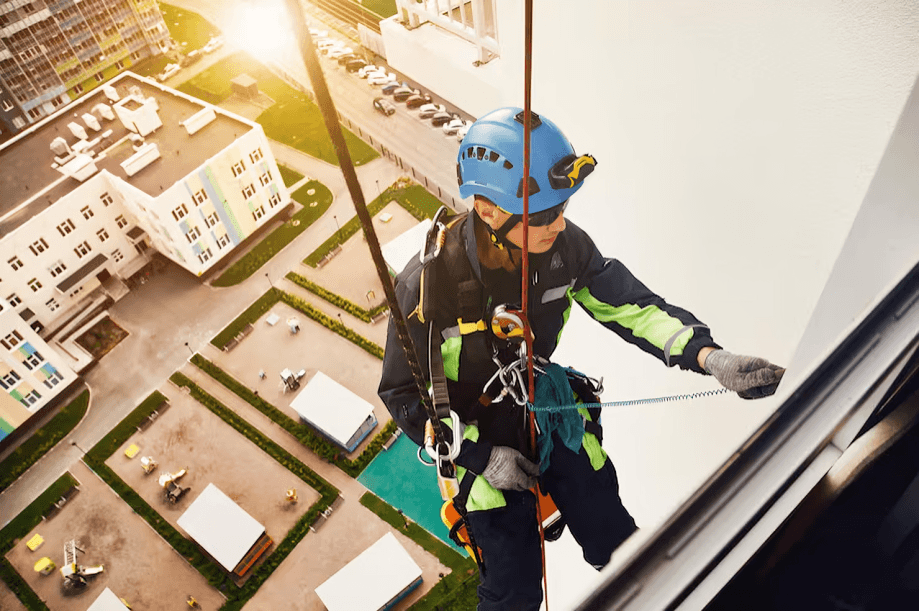
Rope access is a specialist height-access technique that uses ropes, harness systems and certified anchoring points to allow technicians to safely descend, ascend and traverse building façades.
Originally developed for offshore oil rigs and industrial environments, it is now one of the most widely used methods for high-rise maintenance worldwide due to its flexibility and efficiency.
Key Advantages of Rope Access in High-Rise Cleaning Projects
1. Unmatched Access to Complex Building Structures
Rope access allows technicians to reach virtually any surface, including:
- Vertical glass façades
- Curved architectural surfaces
- Narrow gaps and recesses
- Overhangs and irregular structures
No part of the building is out of reach, making it ideal for modern architectural designs.
2. Rapid Setup and Minimal Preparation Time
Unlike heavy machinery systems, rope access requires:
- Minimal ground equipment
- Quick anchor installation
- Fast mobilisation (often under one hour)
This significantly reduces downtime before cleaning begins.
3. Highly Cost-Effective Operations
Rope access eliminates many traditional cost factors:
- No machinery rental fees
- No fuel consumption
- Reduced manpower requirements
- Minimal logistical overhead
This often results in lower total project costs compared to EWPs.
4. Exceptional Safety Standards with Certified Technicians
Professional rope access technicians are typically certified through IRATA or SPRAT systems. These standards require:
- Rigorous training
- Strict safety protocols
- Redundant backup systems
- Continuous supervision and compliance checks
When properly executed, rope access has one of the strongest safety records in the access industry.
5. Minimal Disruption to Building Operations
Because rope access requires very little ground space:
- Pedestrian access remains open
- Business operations continue normally
- No road closures are usually required
- Noise levels remain low
This is especially beneficial for commercial buildings, hotels and retail environments.
6. Environmentally Responsible Cleaning Method
Rope access significantly reduces environmental impact by:
- Eliminating fuel-powered machinery
- Reducing emissions and noise pollution
- Supporting low-water or eco-friendly cleaning systems
This makes it a more sustainable option for modern building maintenance.
7. Multi-Service Capability Beyond Cleaning
Rope access is not limited to pressure washing. It can also be used for:
- Façade inspections
- Window replacement and glazing repairs
- Waterproofing and sealing
- Painting and surface restoration
- Bird proofing and installations
This makes it a long-term maintenance solution rather than a one-time cleaning method.
Direct Comparison: Rope Access vs EWPs for High-Rise Cleaning
| Factor | Rope Access | EWPs |
|---|---|---|
| Access Capability | Full access to all building areas | Slower with logistics and staging |
| Setup Time | Fast (often under 1 hour) | Slower with logistics and staging |
| Cost Efficiency | Generally lower overall | Higher due to equipment and fuel |
| Safety | Highly regulated with backup systems | Dependent on terrain and machinery |
| Environmental Impact | Low emissions, minimal footprint | Higher fuel use and noise |
| Site Disruption | Minimal disruption to operations | May require closures or restrictions |
| Equipment Capacity | Lightweight tools only | Heavy machinery capability |
When Elevated Work Platforms Are Still the Right Choice
Although rope access is more versatile, EWPs still have specific advantages in certain situations:
- Low-rise or mid-rise buildings with open surrounding space
- Projects requiring heavy-duty equipment lifting
- Sites without suitable anchor points for rope systems
- Large flat surfaces where reach is not an issue
In many real-world projects, a hybrid approach is often the most practical—using EWPs for accessible zones and rope access for complex or hard-to-reach areas.
Final Verdict: Why Rope Access Is the Preferred Choice for Modern High-Rise Cleaning
For most high-rise pressure cleaning projects, rope access offers a more flexible, cost-efficient and minimally disruptive solution compared to EWPs. Its ability to access complex architectural structures without heavy machinery makes it especially suited to modern city skylines.
As buildings continue to grow taller and more architecturally advanced, rope access is increasingly becoming the industry standard for façade maintenance—delivering safety, precision and efficiency without the logistical burden of traditional equipment.
Specialist High-Rise Rope Access Pressure Cleaning Services
Professional rope access teams provide expert façade cleaning solutions for buildings of all heights and complexities. Using certified technicians, advanced safety systems and modern cleaning techniques, they deliver consistent, high-quality results with minimal disruption to occupants and daily operations.
Whether dealing with pollution buildup, weather staining or scheduled maintenance programs, tailored rope access cleaning services ensure your building remains visually clean, structurally protected and professionally maintained throughout the year.

