

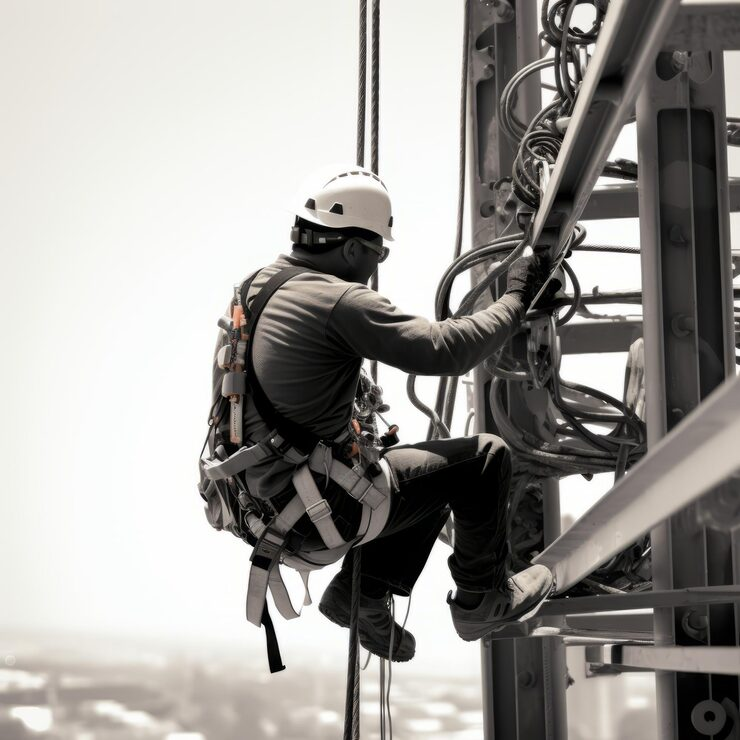
When most people hear the terms abseiling and rappelling, they picture charity descents from tall buildings, adrenaline-seekers lowering themselves down tower blocks or recreational climbing adapted for urban environments. While those scenarios do exist, what is often referred to as “abseiling work” in the professional world is actually a far more technical and highly regulated discipline known as industrial rope access.
From high-rise maintenance and façade repairs to detailed structural inspections, rope access technicians operate across the built environment using advanced rigging systems, strict safety procedures and internationally recognised training standards. What may look like simple “abseiling down a building” is, in reality, a precise and methodical work-at-height system carried out by highly skilled professionals.
This article explains what abseiling and rappelling really mean in a modern industrial context, the types of work involved and why rope access has become the global standard for safe work at height.
What Is Abseiling and Rappelling?
Abseiling and rappelling refer to the controlled use of ropes to descend, ascend or position a worker on structures in order to carry out tasks at height. These techniques are commonly used on a wide range of built environments, including:
- High-rise commercial buildings
- Residential towers
- Stadiums and arenas
- Car parks and concrete structures
- Bridges and transport infrastructure
- Shopping centres and retail complexes
- Industrial estates and warehouses
Unlike recreational abseiling, which is typically short-term and activity-based, industrial abseiling and rappelling are used as access methods to complete essential maintenance and operational tasks safely and efficiently.
These tasks can include:
- Cleaning
- Inspection
- Maintenance
- Repairs
- Surveys
- Installation work
Although the public often uses the terms abseiling and rappelling, the correct professional term is rope access—a globally recognised system designed specifically for safe work at height.
Abseiling and Rappelling vs Rope Access: What’s the Difference?
Although the terms are often used interchangeably, there is a clear and important distinction between them.
Abseiling and rappelling
This is a general, informal description of rope-based movement on structures. It refers to what people visually observe—workers descending or positioning themselves on ropes on buildings or infrastructure.
In simple terms: abseiling = what the public sees.
Rope access
Rope access is the formal, regulated system that governs how this work is carried out safely and professionally. It is built on structured training, documented procedures and strict safety standards.
In simple terms: rope access = how the work is actually done.
Rope access technicians are not recreational climbers. They are trained industrial specialists who:
- Use complex rope systems and anchor points
- Perform dynamic risk assessments
- Work as part of coordinated teams
- Follow strict safety protocols
- Operate under internationally recognised standards
For many organisations searching for “abseiling and rappelling services,” what they actually require is the reliability, safety assurance and professional capability provided by rope access teams.
Why Rope Access Is the Professional Standard for Abseiling and Rappelling Work
The global benchmark for rope access operations is set by IRATA (Industrial Rope Access Trade Association), which developed its systems originally within the offshore industry. Today, IRATA standards are widely adopted in urban environments due to their strong safety performance and structured approach.
Industry-leading safety performance
IRATA’s safety record is among the strongest in the work-at-height sector. Across tens of millions of logged working hours, incident rates remain consistently low, reflecting the effectiveness of training, supervision and operational discipline.
Built-in redundancy systems
Every rope access technician works with two independent systems: a working rope and a safety rope. If one system fails, the second provides immediate protection. This redundancy is a core reason rope access is considered one of the safest access methods available.
Mandatory rescue capability
Teams always include advanced technicians trained in rescue procedures. This means that in the event of an emergency, rescues can be carried out immediately on-site without waiting for external emergency services.
Competence-based progression
IRATA qualifications are structured across Levels 1, 2 and 3. Progression is based on verified experience, logged hours and formal assessment—not time alone—ensuring technicians only advance when genuinely competent.
Strict documentation and compliance
Every project requires detailed risk assessments, method statements, equipment inspection records and rescue plans. This creates full accountability and ensures compliance with industry regulations and client requirements.
What Types of Work Require Abseiling and Rappelling?
Rope access supports a wide range of essential maintenance and construction activities across the built environment.
High-level cleaning and building maintenance
One of the most visible uses of rope access is external cleaning and maintenance. This includes window cleaning, façade washing, debris removal, gutter clearance, minor cladding repairs and pressure washing. Because it requires minimal ground equipment, disruption to occupants and the public is significantly reduced.
Urban inspection and surveying
Rope access technicians are widely used for detailed inspections of buildings and infrastructure. This can involve identifying structural defects, checking fixings and bolts, supporting engineering surveys and capturing photographic or video evidence. Advanced tools such as thermal imaging and drone-assisted surveys may also be used.
Installation and repair work
Technicians can install signage, lighting systems, CCTV equipment, cabling, bird deterrents and structural anchors. Their ability to position themselves precisely at height removes the need for scaffolding or mechanical platforms in many cases.
Painting and protective coatings
Rope access is frequently used for façade painting, steel protection, corrosion treatment and surface preparation. It is especially effective in urban areas where scaffolding would be disruptive or impractical.
Emergency and reactive works
In urgent situations such as storm damage, loose cladding or falling debris risks, rope access teams can respond quickly to secure hazards and carry out immediate safety measures.
Why Training Is Essential for Abseiling and Rappelling Work
Although abseiling may appear simple from the ground, professional rope access is highly technical and requires formal training and certification.
The global standard for this training is IRATA certification, which ensures technicians can operate safely in complex urban environments involving public interaction, weather exposure and structural hazards.
Urban rope access work demands strict competence because technicians may operate near traffic, pedestrians, glass façades and active buildings. Proper training ensures they can manage these risks effectively while maintaining safety and efficiency.
Why Companies Choose Rope Access Over Scaffolding in Cities
As modern architecture becomes more complex, rope access has increasingly replaced traditional scaffolding in many urban projects.
One of its key advantages is efficiency. Rope access requires minimal setup, meaning work can begin faster and finish sooner without large-scale structures, street closures or prolonged disruption.
It also offers environmental benefits. With fewer materials, reduced transport requirements and no scaffold erection or dismantling, rope access typically results in a lower carbon footprint compared to traditional access methods.
In dense urban environments, flexibility is another major advantage. Rope access allows technicians to reach difficult architectural features quickly and safely, making it ideal for modern building designs where access is often limited.

